Monday, August 13, 2012

Immortal Flower: Like a Medieval Tapestry


I’m back!  It was a lovely vacation – lots of swimming, sitting and reading. But now I’m back and ready to post what I’m sure you’ve all been waiting for…the continuing story of Immortal Flower!

When we last left Mandy (a secretary working for a Professor in Tunisia), she, the Professor, his nephew Steven Heron and the glamorous Renata were all about to head off to Sheik al Hassan’s place for an exciting ‘medieval’ festival.  Would Mandy see the Sheik’s son, handsome Ramon, in a new light at that festival?

Steven Heron certainly thinks so and he tells Mandy this repeatedly. Initially, he’s almost as annoying as the marabout, in terms of vague warnings about possible disaster for Mandy.

Mandy wonders about Steven’s obvious protectiveness.  This is a popular romance set-up in the 60s and 70s – man doesn’t seem to the heroine to think much of her, but he’s always getting involved in her business, fixing things for her and meddling in her romantic affairs. In this case, there’s one possible explanation for the romantic affair meddling: racism. But Mandy thinks that “it was too simple to think it might be racialism.  Steven with his numerous Arab contacts at the University was far too intelligent and cosmopolitan for any kind of racial prejudice” (62). So it must be something else…

She’s equally puzzled when Steven buys her a “multi-stranded necklace of copper medallions and beads, showy but artistic because of the native handcraft which had been put into it” (65) in the souks of Tunis. Why would he do such a nice thing?

Because he likes you, of course! He’s just stuck in his role and thus is unable to tell you this! Unlike in The Sheik, however, we only get Mandy's narrative point-of-view and thus must wait for Steven to actually say things to know what he's thinking...

But on to the great adventure – their trip to El Habes and the Sheik’s palace. This trip is actually much less dramatic than I was expecting it to be. I was expecting some sort of kidnapping or maybe a trip into the desert or something, but mostly they just stay in the Sheik’s beautiful palace and see some horsemanship.

Mandy, Renata and the Professor fly to El Habes in the Sheik’s own private airplane, while Steven travels there in his old jalopy, since he is reluctant to trespass on the Sheik’s hospitality. The palace is beautiful, but it is also marked by the presence of the Sheik’s armed soldiers who make Mandy nervous.  Being a Sheik in this novel is a much different matter than in E. M. Hull’s The Sheik. Sheik el Hassan has an army and a large palace. He is not the nomadic desert figure of the Rudolph Valentino sheik. 

As yet, the sheik romances I've read for this blog haven’t had any significant speaking parts for Arab women and Immortal Flower doesn’t seem to look like it will provide one.  Sheik el Hassan has a young second wife, but, unlike the Sheik, she doesn’t have any lines. Instead she is described as having a “small perfect face” with “kohl-darkened eyes” (73) and chatting with Renata in French.

What the novel does have is a visible presence of Islam, something which is often absent from many later sheik romances. It’s interesting that while Islam is both named in the book and has a presence in characters' actions, while the ‘Western’ characters are almost certainly Christian they never go to church or do anything visibly 'Christian'. When they were visiting Tunis, Mandy and Steven had seen a group of men at prayer. Now, at the palace, Renata explains to Mandy (or rather, the reader) that “Friday, as you know, is the Moslem holy day of the week” (73).

On Friday, after prayer, there is the procession which begins the festival, led by the Sheik in “robes of purple and gold, riding his white horse like a king” (75).  Also in the procession is Ramon, who looks, to Mandy “so different from her beach and dance-floor companion” (76).  It seems as if he “might have been a figure in a medieval tapestry” (78).  Hoy really does tie everything back to the ‘medieval’. 

Part of the festival is a mock battle and set of displays on horseback. This is about as dramatic as the visit gets, I’m afraid, but it does get Mandy’s heart pounding when Ramon, the leader of one of the group of riders, “his sword held aloft, uttered a bloodcurdling yell, swung his mount aside and missing the dais by inches guided the galloping chargers harmless away back on to the open plain” (83). She’s also alarmed when Ramon strikes a man in the course of the mock battle.

And when Ramon for the first time notices that Mandy has been there to see the display, he is very dismayed. I’m not clear why either of them is really so upset by this whole interaction. If fact, Mandy herself doesn’t seem so clear. She thinks to herself that “what she had seen was no worse than many contests of strength of skill put on in England – boxing matches, for instance, or Rugby football” (85). Why is it that she's so upset, do you think? Yet she is upset, and Steven tells her that he’s glad she’s seen Ramon in this context. He thinks that this will stop her from “making a fool of herself over him” (87).

Of course, they fight about this.

And that’s it. That’s the trip. Oh, except for the fact that Renata wears a fabulous outfit modeled on an Arabian dress (a “dress that was all dark violet draperies trimmed with bands of gleaming gold”) to the final banquet. And Ramon tells Mandy that he’ll call her soon.

When they return, Mandy goes back to her usual life, transcribing papers for the Professor and swimming at the beach by herself or with Steven. It seems like the episode has put her off Ramon a bit, if she ever was seriously interested in him romantically. When Ramon finally calls, though, they go out to dinner at the big hotel. Mandy dresses up and gets her hair put in ringlets and Ramon gazes at her soulfully. On their way up to the hotel they meet the marabout and chat a little. 

And then…almost out of the blue…Ramon proposes! Or rather, gets halfway through a proposal before Steven and Renata appear literally out of the bushes (or rather the oleander flowers) and crash their party.

His interrupted proposal is a rather dramatic one:

“With your hands in mine I have the courage to say all that I long to say. You are so tender, so gentle. The desert with its hardened warriors, its cruelties, its loneliness is not your world. That it is mine is…accidental, a burden I am supposed to take up and bear. But I need not take it up. I could go away, with you to help me” (104). 

“Mandy! Mandy!” he implores and then Steven and Renata appear, obviously having been informed by the marabout that this meeting was underway and deciding for their own reasons to mount a ‘rescue operation’. 

Thus, Mandy does not have to decline Ramon’s proposal and avoids an awkward conversation. But then again she also doesn’t decline Ramon’s proposal. It’s clear that that may cause trouble in the future.

And that’s where we will leave things for now. Why are Renata and Steven so determined to protect Mandy from Ramon? And what is the closeness between them? Are they romantically involved, as Mandy assumes? And how exactly is horseback riding in a djellabah medieval?

Friday, August 3, 2012

On Vacation! Back soon...

No posts today or next week. I'm going on vacation for the long weekend.  I will be back on August 13th with the next installment of Immortal Flower... Will Mandy get herself into trouble at the Sheik's big party? Why does Steven keep on warning her about Ramon? And how did Renata get so fabulous?

Have a great long-weekend!

Wednesday, August 1, 2012

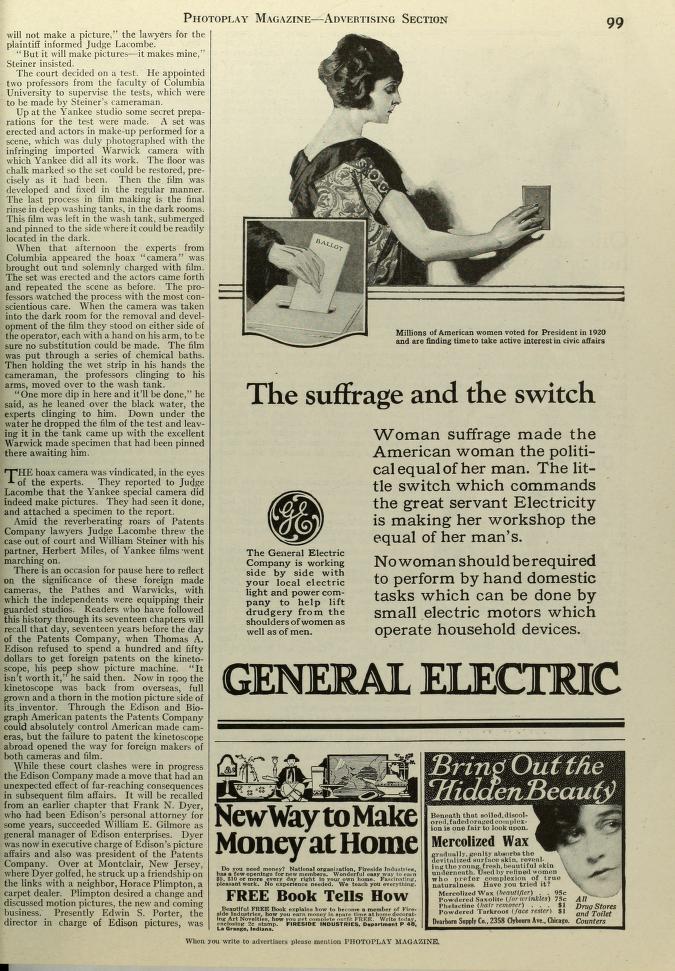
Ads from the Orient!

Well, not so much from the Orient as using the ‘Orient’ to sell things. Mostly perfume. These ads are all from Volume 24-25 of Photoplay (July-December 1923), found, as usual, on the Internet Archive.

First, you knew we couldn’t escape Valentino:

Made of lava, I presume?

See the ad.

The illustration probably refers to Valentino’s role in the film Blood and Sand (1922), which was not a sheik film but a film about a Spanish matador (Valentino) who is married to a virtuous woman and has an affair with a seductive widow, Doña Sol

Inside reference alert: in Court of the Veils, Duane Hunter refers to Isabela (the opera singer) as Doña Sol. Everything sheik connects to everything else sheik!

Anyway, the ad is for a face cream recommended to Valentino by his wife Winifred Hudnut (seen in this previous post). Apparently it builds up the facial muscles! And for only $2.00 (plus $1.50 for the Face Finish).  About $26.00 in today’s money, according to a random inflation calculator. So, pricey? Not pricey? I don't buy many face creams...

If you like that, you might like Vantine’s Temple Incense:


Lie back and relax...


This incense promises to bring you “all the mystery, the beauty and the lure of Eastern Romance”. And from the look of the woman in the illustration, it’s pretty alluring…

And then we have an advertisement for Sax Rohmer’s ‘Masterpieces of Oriental Mystery’:

Adventure, Romance, Sorcery, Secrets!


Sax Rohmer wrote a lot of ‘Oriental’ Mysteries (he’s best known for his mysteries featuring Dr. Fu Manchu). These ads are very common in movie magazines. This one encourages you to buy now, because this edition is at a special low price due to “a fortunate purchase of paper and other materials made at just the psychological moment”. The ads really capitalize on an image of the East (which includes a wide wide range of places in this case - China, India, Saudi Arabia, etc.) where women are bought and sold by mysterious (and probably unsavory) men.

See also, the Mountain Goats song “Sax Rohmer #1”.

And, finally, this one has nothing to do with sheik movies or romantic Orientalism, but I just love it:

The Great Servant Electricity!


“Millions of American women voted for President in 1920 and are finding the time to take active interest in civic affairs.” Maybe that is because we, GE, give them electrical appliances? We’re just saying…

Movie magazines are a treasure trove of quirky old ads.  I'm sure I will be posting more of them in the future.

Next up, part two of Immortal Flower.

Monday, July 30, 2012

Immortal Flower: Carthage edition


The next book on my pile of romances is Elizabeth Hoy’s Immortal Flower.  It’s a Harlequin Romance first published in 1972.

Everyone look in a different direction

According to http://www.squidoo.com/Elizabeth_Hoy_vintage_Harlequins, Elizabeth Hoy wrote a few books that could be considered Sheik romances: including To Win a Paradise and Flowering Desert. I don't think I have any of her other books, but I could be wrong! She also wrote a number of books set in Italy and Ireland.

Immortal Flower is interesting because it’s in-between a sheik romance with a sheik as a hero and a desert romance where the desert is simply a romantic setting for a romance between two ‘westerners’. As you can see, there are two men on the cover – one Eastern, one Western.  Which one will the girl in green choose?!

It’s quite obvious from the set-up that she’ll choose the Western guy. On the front cover, he's the one looking at her. And on the back cover, he’s the one she finds the most annoying, so we definitely know that he’s the one she’ll end up with. But let’s go along with the ride for fun…

Our heroine Mandy works as a secretary for a professor who is doing research in Tunisia. The professor (Noel Croftwell, a very British Professor name) is a historian and archaeologist who is working on a book on Roman remains in Tunisia, specifically the ancient city of Carthage (of Dido and Aeneas fame). Mandy’s father, John Lavalle is an “authority on Oriental religions, author of the Islamic Encyclopaedia” (11).

Mandy and the Professor have been working in Tunisia for a few short weeks when his nephew Steven Heron arrives for a visit. Steven is a geologist surveying “somewhere in the Sahara” (9). When he arrives, exhausted from his trip, he’s very brusque and rude to Mandy, describing her to his uncle as a “red-headed dolly” (11).  Not a very good first impression.

The three main men in Mandy’s life, then, all study some aspect of ‘the East’ for a living: as a historian, religious scholar and geologist. Mandy, on the other hand, left University to take a secretarial course, as she felt her Arts degree was too un-directed. As she thinks of it, “if secretarial work hadn’t quite the same snob value as being able to call yourself a B.A. it at least promised movement and variety” (21). Mandy’s feelings about being an 'ordinary' woman surrounded by intellectuals are a recurring theme throughout the novel.

There is also a fourth man, Ramon al Hassan, who Mandy met at the beach and has been swimming with regularly, despite not knowing much about him. He is a “golden boy, with a body like a slim bronze god” (17). And very charming, unlike Steven.

Mandy, the Professor and Steven go out for dinner at the local fancy hotel and run into Renata Castella – our Other Woman. Hopefully she won’t turn out as terrible as the opera singer from Court of the Veils. Renata is a half-Italian, half-American “dilettante writer who lives in a magnificent old Moorish palace on the outskirts of the Tunis Media” (23). She’s a beautiful, exotically dressed widow; her husband was a race-car driver who died in a crash. And in her party is Mandy’s beach friend, Ramon, who Steven reveals is “the eldest son of an oil sheik who lives in a fabulous palace on the edge of the Sahara” (24).  Apparently, Ramon’s father is not the best of friends with Steven, as he suspects Steven of being a prospector or a spy for English oil interests. Not entirely unreasonably, I would think…

And thus we have our cast of characters all assembled. Mandy is already a little disillusioned with Ramon’s attitudes, for example, his fondness for veiling: “all this Oriental pomposity and male dominance…it struck her as prehistoric! And yet Ramon had been around, living in Cannes and in Paris.  But whether he realized it or not, his roots, it seemed, were in that sheikdom on the edge of the desert” (33).  On the other hand, she’s increasingly jealous of the attention that Steven is paying to the glamorous Renata and annoyed by Steven’s warnings against getting involved with Ramon. Steven too has some out-dated ideas: “the he-man type, like Steven went  about imagining girls were poor helpless creatures who couldn’t take care of themselves and had to be protected; a middle-aged viewpoint totally out of date” (44).

Renata, hearing of the Professor’s interests in Roman ruins, invites them all to come along with her to a party that Ramon’s father, Sheik al Hassan is throwing: “a period of festivity – a gathering of the clans, including Army manoeuvres, riding contest, and jousting, reminiscent of the old days of medieval English chivalry” (49). Another quote to add to Amy Burge's work on the use of 'medieval' in sheik romances. But a marabout “in floating white robes” with “strange depths in his dark eyes” warns Mandy that there is “a difficult and dangerous path ahead of [her]” and advises her to “walk warily” (53). So seldom do Christian mystics advise heroines to beware. It's always Gypsies and marabouts...

So I’m guessing there will be adventure at this party! I’m looking forward to it…

Friday, July 27, 2012

Court of the Veils: women are also jaguars…


As planned, Duane, Tristan, Isabela and Roslyn go on a trip into the city. On their way in they pass by some Oriental tropes: Isabela is as “proud and distant as Queen Nefertiti” (83) and the scene around a water-hole has a “Biblical quality, unchanged down the centuries” (84). 

Ivan Kalmar, a professor at the University of Toronto, has argued in fact that paintings of Biblical scenes were influenced by contemporary fashions in the ‘East’. So perhaps this ‘Biblical quality’ is more related to tropes of representing the Bible than the persistence of an unchanging style in 'the East'…

In more self-referentiality, Isabela remarks that “real Arabs were certainly not like the sheiks in novels and films” and Duane agrees: “I should hope not! […] those are real men and women, hewn out of the fire and ice of their land. In actual fact, a desert sheik is little more than a shepherd, a nomad wanderer who opens his eyes for the first time in a hair tent, who marries a girl of his own tribe and rarely takes a second wife, let alone a third or a fourth” (84).

The four enjoy the city, shopping in the souk, going out for dinner and dancing (Roslyn quite poorly). At night, Roslyn goes down to the lake by their hotel, to clear her mind and runs into Duane – and another romance plot-line.  They get caught in the rain and have to take shelter in a boatshed and ‘get out of those wet things’, if you know what I mean.

They have to stay in the shed overnight, because a landslide has blocked the path back up the hotel and it’s too dangerous to try to climb it at night. When Duane takes off his shirt (Just to go to sleep, I promise! We aren't in the 80s yet. While The Sheik may have had pre-marital sex, this book does not.), Roslyn sees the jagged scar on this shoulder, from his years in the jungle, she assumes: “a jaguar hiding in a tree, leaping down when his back was turned and rending his body…as that woman he had known had rended him on the inside” (128).

But in seriousness, they bond during the night, as Duane tells Roslyn about his father moving to England and his own choice to come to Dar Al Amra. Roslyn, of course, has no stories of her own to tell, as she still has no memories…

The next morning, they both sneak back into the hotel and, for some reason, don’t tell anyone  about it.  It’s really not clear why.  It would be too scandalous? They like having a secret little secret? Roslyn and Tristan go on horseback rides together, Roslyn hangs out with Nanette and when she goes into town with Tristan, learns about the improvements that Duane is planning with the locals.  He has started a Food Association Board and is friends with the man who will be the headman when the current headman dies, who wants modernization: education and new crop-growing schemes.

In another Biblical reference, Tristan suggests that whoever marries Duane “will have to fold her tent like Ruth and dwell with him in the desert” (154), like any daughter-in-law should (well, he doesn’t say that part, or the part where she later seduces some guy named Boaz).

Foreshadowing?

Finally, a crisis arrives. Nanette becomes ill. Duane calls in Dr. Suleiman, who represents the highly qualified modern Arab, trained in Algiers and in England, but come back to El Khadia to help the local people. And… you’ll never guess… his hands are “narrow and shapely as a woman’s” (160). So I guess this is a thing, at least in sheik romances!

Nanette apparently needs just a bit of bed-rest, so Roslyn takes over her nursing. Isabela is getting restless because she is not having enough attention paid to her. This bit then comes out of the blue: 

There is a sandstorm coming, but Isabela persuades Roslyn to come for a drive with her. She interrogates Roslyn about her and Duane’s relationship and then tricks Roslyn into getting out of the car and leaves her behind! In the desert! With a sandstorm coming! It’s very dramatic, and Isabela has been set up as selfish and temperamental, but it does seem like a bit much. 

Luckily Duane happens to be driving by and he rescues Roslyn.  He also reveals to her the secret of his cynicism around love. It was his mother! She was selfish like Isabela and after a series of affairs left his father, running away with a wealthy Brazilian only to be killed in an earthquake. After this revelation, the sandstorm hits and Roslyn hits her head on the front of the car. And…

Recovers her memory, of course! 

She is indeed Juliet Grey, just as Duane suspected. This prompts Duane to kiss her: “his mouth on hers was relentless, hurting her until she ceased to struggle…then, eyes closed, senses fully awake, she surrendered to the kiss that searched through all her being until it plundered the heart right out of her” (184). Duane reveals he loves her and she, of course, loves him. And then he gives her a ring.

I may have been a little snarky about this book's plot, but it is actually quite pleasant to read (despite the endless ruminations on the nature of love). The ‘local colour’ details are evocative. Morocco serves as a wonderful setting, and the novel is very revealing about the remainders of French colonialism (in a non-political way), but Moroccan people are only background actors in the story. I'm not sure any Moroccan women even have any lines...

Next up, Immortal Flower. This one has two potential heroes on the cover: a Tunisian man and a British man (I think).  Who will the heroine choose?

Wednesday, July 25, 2012

What does your signature reveal about you?

This week’s 1920s magazine post is from Movie Weekly, which is a bit more…sensationalist...than Photoplay (and Photoplay is not even that restrained, really).

Well, is it?
From Movie Weekly April 8, 1922. Click here to read the article.

Movie Weekly March 4, 1922 also has a pretty fabulous photo of Rudolph Valentino in his Sheik costume. Actors really stared in those old publicity photos. They’re looking at you, yes, you. Shhh…don’t speak, don’t speak.

And his hands do look large!
On page 6 and 7 of that issue is an article on what the movie stars' signatures reveal about them: 


“Success of Favorite Movie Stars Explained in Their Handwriting”
Click here to see the article more closely.

This is part two of a series! And apparently there will also be a ‘surprise handwriting’ article in an upcoming issue, if you happen to be a graphology enthusiast. The article begins with the classic space-filler found in many undergraduate essays – a definition:

“Fame has many faces. To be famous signifies the recognition of some sort of success achieved.”

Yes…go on…

“And no surer fashion of determining the essential elements which make for high popular acclaim can be found than that which an individual exhibits in handwriting. It is the intimate link between the nerve-action of the hand and the mind.”

I’m not convinced, but I’m willing to be entertained.

The signature of Constance Talmadge (star of films like Happiness a la Mode (1919) and Romance and Arabella (1919)) reveals that “her affections are potent, but her humorous eye would seize the amusing side of anyone who tried to be serious in a motor car.” 

So never drive anywhere with her, I guess.

Rudolph Valentino’s “even, well-poised fist moves ambitiously upwards, gesturing with his rather flamboyant capitals, exclamatory of his intense vitality and the conscious belief in himself.” Apparently, his “advance along the stellar way can be measured by the height of his signature. Very high.” 

This seems…a bit of a stretch?

The signature of Gloria Swanson (the woman standing in the riding pants) has a “virile swing” to match her “vigorous personality”.

Frankly, all of these descriptions sound the same to me! What do you all think? Are you convinced of graphology's vital utility?

Next up: the conclusion of Court of the Veils. For real this time!

Monday, July 23, 2012

Court of the Veils: And the Desert is like a Woman, of course!


Back to our heroine ‘Roslyn’ and her encounters with the Gerard family. There is one more character in this book who I failed to mention on Friday: The Other Woman.

Romances from this era often have an Other Woman character who serves as a foil to the heroine.  Where the heroine is innocent and unworldly, the Other Woman is glamorous and very, very worldly. Court of the Veils’ Other Woman is Isabela Fernao, a Portuguese opera singer who is working on an opera with Tristan. She is, of course, very beautiful, very seductive and very self-centred. Is Isabela interested in Tristan or in Duane or neither or both?

This novel has many, many philosophical discussions of love in it. Does love exist? What is it exactly? How should love be? It’s funny because even though it’s a constant topic of conversation, it doesn’t really seem to be a theme in terms of the plot (beyond, of course, the fact that this is a romance). We don’t have a couple of different couples engaged in different kinds of love. Or even one character who moves through different expectations of love, at least not from my reading. So why so much talk of it?

Anyway, the first of these discussions is between Tristan and his grandmother.  All this talk of love is very operatic, and this conversation starts with opera:

“‘To love is to be burned in the flames of passion and disillusion, grand’mere.’ He seated himself at the piano and shot her a smile.

‘Your cynicism almost matches Duane’s,’ Nanette said tartly. ‘Love can be a most enjoyable emotion, but you young people of today seem to regard it as a battle.  I suppose we can all expect the finale of your opera to be a tragic one, cheri, though in all likelihood Nakhla was merely fascinated by her soldier admirer, and in love with her master.  A woman cannot help loving her master.’

‘You are an incurable romantic, grand’mere,’ Tristan chuckled, and played a snatch from The Merry Widow.” (23)

No comment.

Court of the Veils has some quite enjoyable descriptions of the décor and setting, which double as ‘eastern’isms. Roslyn’s room has a ‘strange Eastern charm’: it’s “white-walled, and beamed with cedar.  The bed was low, with tall posts holding back yards of misty net as a safeguard against the intrusion of insects.  Squares of oriental carpet covered the floor, and the windows were narrow harem-lattices covered with mesharabeyeh [which are, according to Wikipedia, those lattice-y windows, so Winspear has basically repeated the terms here to offer both the explanation and the ‘authentic’ term]. There were deep window recesses beneath the lattices filled with cushions, a cupboard for her clothes, and a carved chest with mirror-stand upon it” (24).

I would like this room.  Of course, if I had it, it would also be covered in piles of paper and books. But still very picturesque, I’m sure!

In sheikh romances, though, pretty rooms are seldom just pretty rooms.  Often they’re reminders – of luxury, decadence or the Oriental past which is still present. Thus, Nanette tells Roslyn that her room was probably ‘long ago’ the room of ‘a favourite of the harem’: “in the days of female seclusion in the East, when the master of the house handed to his fancy of the moment a coloured veil to indicate that she was to be brought to him that night.” Roslyn replies, “what a catastrophe if the master wasn’t attractive,” but Nanette thinks otherwise: “The Aga was said to be a fiercely handsome man, so there is every likelihood that the inmates of his harem fought to win a veil from him.  These veils were added to their everyday wear.  A particular favourite would probably be clad in little else.” (25)

So many things to say about this – ‘the East’ exists here in a kind of limbo fairy-tale time of ‘long ago’ where there is a place called ‘the East’ where customs were all the same. Yet there’s a specific handsome Aga. And the veils! I do not know if this is actually a thing, but it really sounds like an Orientalist fantasy. Pics or it didn’t happen.

Well, Roslyn spends most of her time at Dar al Amra hanging out with Nanette and Tristan and occasionally crossing swords with Duane.  Duane ticks another of the boxes on my imaginary Bingo card by comparing the desert to both a woman and a horse:

“After four years I’m not certain whether I love its moods, or hate them. I sometimes think I like the desert best when it is wild, untamed, like a horse to be broken, or a woman.” (35)

Duane has some issues. He’s very cynical about love. He compares love to a peach – with a stone at its heart. Frankly I think he is missing the point of peaches, which are delicious! He is also suspicious of Roslyn. But he’s a very good plantation manager, apparently.

And he saves Roslyn from being attacked by a mountain cat while she’s wandering among the date palms. So there’s that.  He takes her to his house (he lives separately from Nanette) for a drink to recover her composure. And there he makes dragonflies – dragonflies! - sound wild and untamed (which I guess technically they are, but still?): “The male dragonfly is utterly ruthless towards its mate, you know” (55).

Violet Winspear cannot let an animal just be an animal (or insect, as the case may be). It must be a ruthless, stalking, masculine kind of animal, or an animal to be tamed.

On the other hand, Roslyn gets along with Tristan very well. In these types of novels, I’m never really sure why it is that the heroine doesn’t end up with the person she gets along with, who’s actually nice to her. I suppose it may be that that person also does have some flaws – often they’re too easy-going, or would like to live in a busy city, or are actually a bit of a playboy. I mean, sure, you love who you love, but if it’s as easy to love a rich man as a poor one, why shouldn’t it be as easy to love a hot guy who’s nice to you as a hot guy you argue with all the time? Maybe that’s more revealing of my own personal relationship interaction preferences than anything else, though...

Anyway, the reason I bring this up is that Tristan and Roslyn kiss, after yet another philosophical discussion of love. They’re interrupted by Isabela, though, who is suitably tart about the whole thing. Roslyn still thinks she was engaged to Armand, so she’s feeling a little iffy about having kissed Tristan (his brother!). But we don’t mind, because we know she’s not really Roslyn…

Wow. I’m finding it really hard to do a whole novel in under three posts. I can’t believe I initially thought I would do one post per novel! I’m guessing I may get down to one or two posts per novel as I get through more of them, but for now, I’m afraid Court of the Veils is going to be going onto a third post…

Up next: All of the younger generation are about to take off for a weekend to the city of El Kadia… But before that – movie Wednesdays! I’ve been finding some more great stuff in the archives…