Showing posts with label Valentino. Show all posts

Wednesday, August 1, 2012

Ads from the Orient!

Well, not so much from the Orient as using the ‘Orient’ to sell things. Mostly perfume. These ads are all from Volume 24-25 of Photoplay (July-December 1923), found, as usual, on the Internet Archive.

First, you knew we couldn’t escape Valentino:

Made of lava, I presume?

See the ad.

The illustration probably refers to Valentino’s role in the film Blood and Sand (1922), which was not a sheik film but a film about a Spanish matador (Valentino) who is married to a virtuous woman and has an affair with a seductive widow, Doña Sol

Inside reference alert: in Court of the Veils, Duane Hunter refers to Isabela (the opera singer) as Doña Sol. Everything sheik connects to everything else sheik!

Anyway, the ad is for a face cream recommended to Valentino by his wife Winifred Hudnut (seen in this previous post). Apparently it builds up the facial muscles! And for only $2.00 (plus $1.50 for the Face Finish).  About $26.00 in today’s money, according to a random inflation calculator. So, pricey? Not pricey? I don't buy many face creams...

If you like that, you might like Vantine’s Temple Incense:


Lie back and relax...


This incense promises to bring you “all the mystery, the beauty and the lure of Eastern Romance”. And from the look of the woman in the illustration, it’s pretty alluring…

And then we have an advertisement for Sax Rohmer’s ‘Masterpieces of Oriental Mystery’:

Adventure, Romance, Sorcery, Secrets!


Sax Rohmer wrote a lot of ‘Oriental’ Mysteries (he’s best known for his mysteries featuring Dr. Fu Manchu). These ads are very common in movie magazines. This one encourages you to buy now, because this edition is at a special low price due to “a fortunate purchase of paper and other materials made at just the psychological moment”. The ads really capitalize on an image of the East (which includes a wide wide range of places in this case - China, India, Saudi Arabia, etc.) where women are bought and sold by mysterious (and probably unsavory) men.

See also, the Mountain Goats song “Sax Rohmer #1”.

And, finally, this one has nothing to do with sheik movies or romantic Orientalism, but I just love it:
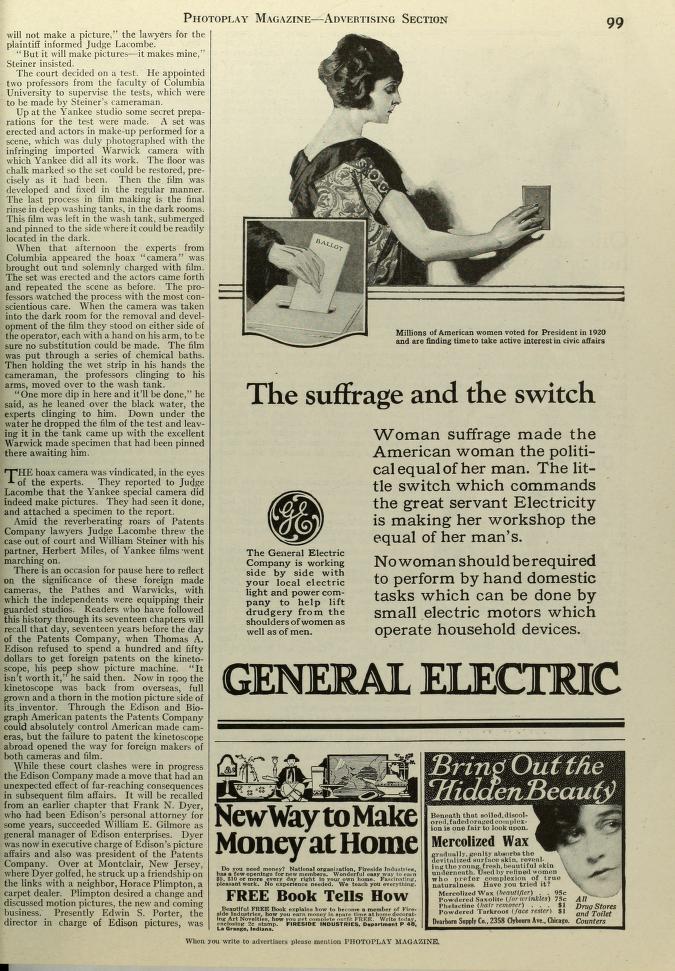
The Great Servant Electricity!


“Millions of American women voted for President in 1920 and are finding the time to take active interest in civic affairs.” Maybe that is because we, GE, give them electrical appliances? We’re just saying…

Movie magazines are a treasure trove of quirky old ads.  I'm sure I will be posting more of them in the future.

Next up, part two of Immortal Flower.

Wednesday, July 25, 2012

What does your signature reveal about you?

This week’s 1920s magazine post is from Movie Weekly, which is a bit more…sensationalist...than Photoplay (and Photoplay is not even that restrained, really).

Well, is it?
From Movie Weekly April 8, 1922. Click here to read the article.

Movie Weekly March 4, 1922 also has a pretty fabulous photo of Rudolph Valentino in his Sheik costume. Actors really stared in those old publicity photos. They’re looking at you, yes, you. Shhh…don’t speak, don’t speak.

And his hands do look large!
On page 6 and 7 of that issue is an article on what the movie stars' signatures reveal about them: 


“Success of Favorite Movie Stars Explained in Their Handwriting”
Click here to see the article more closely.

This is part two of a series! And apparently there will also be a ‘surprise handwriting’ article in an upcoming issue, if you happen to be a graphology enthusiast. The article begins with the classic space-filler found in many undergraduate essays – a definition:

“Fame has many faces. To be famous signifies the recognition of some sort of success achieved.”

Yes…go on…

“And no surer fashion of determining the essential elements which make for high popular acclaim can be found than that which an individual exhibits in handwriting. It is the intimate link between the nerve-action of the hand and the mind.”

I’m not convinced, but I’m willing to be entertained.

The signature of Constance Talmadge (star of films like Happiness a la Mode (1919) and Romance and Arabella (1919)) reveals that “her affections are potent, but her humorous eye would seize the amusing side of anyone who tried to be serious in a motor car.” 

So never drive anywhere with her, I guess.

Rudolph Valentino’s “even, well-poised fist moves ambitiously upwards, gesturing with his rather flamboyant capitals, exclamatory of his intense vitality and the conscious belief in himself.” Apparently, his “advance along the stellar way can be measured by the height of his signature. Very high.” 

This seems…a bit of a stretch?

The signature of Gloria Swanson (the woman standing in the riding pants) has a “virile swing” to match her “vigorous personality”.

Frankly, all of these descriptions sound the same to me! What do you all think? Are you convinced of graphology's vital utility?

Next up: the conclusion of Court of the Veils. For real this time!

Wednesday, July 18, 2012

Zip! And Valentino’s futuristic abode…


As I mentioned last week, I’ve found some wonderful online archives of movie fan magazines up at the Internet Archive archive.org .  This is a fabulous resource for academics, enthusiasts and those of us who just really like finding old ads for underarm hair removal:
 
It's Off because it's Out!
I’ve been looking through some issues of Photoplay from the early 1920s and finding a lot of wonderful material. Today I’ll just post one photo-spread of Rudolph Valentino in his new house, waiting for his new wife.

And this little tidbit. Valentino, the star of the movie version of The Sheik, generated a lot of press, both positive and negative. The stereotype was that women loved him and men hated him (and thought he was too ‘feminine’). Thus this short ‘Song of Hate’:

http://archive.org/stream/photoplayvolume222chic#page/26/mode/2up

What are ‘oriental optics’? Eyes? Looks? I do love the phrase ‘apt in the art of osculation’.

And here is the man himself, Rudolph Valentino, looking very serious, from the September 1922 issue of Photoplay:

What more can be said of this Latin lover of the film?

These movie fan magazines had much of the same kind of content that Hollywood celebrity magazines have today (gossip about stars, spreads of their homes, interviews, reviews), as well as short fiction, ‘behind the scenes’ industry information, and so on. The following is a photo-spread of the home that Valentino was going to live in with his second wife after his divorce was final, described as “romance in silhouette against futuristic background”:


Photoplay September 1922


The spread, if you want to look at it more closely is at:
  
Their marriage was a bit of a scandal. According to the article, Valentino was not fully divorced from his first wife Jean Acker when he and Natacha Rambova (aka Winifred Hudnut) married in Mexico. There was even, I believe, a bigamy trial? The article says that Rudolph and Natacha designed the house together, but Valentino was living in it alone until they could marry legally in California while Rambova was living with her father Richard Hudnut (“millionaire perfume manufacturer”) in New York.

What a contrast in names! From Winifred Hudnut to Natacha Rambova! She was certainly going for the ‘exotic vamp’ image… Rambova had been a ballet dancer and was at the time an artistic and costume designer.  There were constant rumours in the film press about her relationship with Valentino and the amount of control she exerted over his artistic and business decisions (e.g. the notorious platinum ‘slave bracelet’ she bought him).   

This was common film star gossip (divorces and romances), but also inflected with the anxieties around changing gender relations which marked Valentino’s career. Was he manly enough or was he being controlled by his wife? Were women too sexually attracted to him? Was his foreignness the source of a suspicious sensuality?

More prosaically, though:

The picture of Valentino on the bottom left would be even more arresting in colour, because the caption describes his lounging suit (“from the Chinese”) as bright orange!

And the object on the bottom right is Natacha’s dressing table, apparently designed by Valentino himself with some ‘exotic and unique’ features, including an electric perfume burner. A nod, I suppose to both her exotic image and her father’s manufacturing interests?

Friday, we move forward in time to a sheik romance from the 1970s…

Wednesday, July 4, 2012

“Is the Foreign Lover the Perfect Lover?”


I’m already behind in my reading! It’s been a while since I read The Sheikh but it’s just as outrageous as I remember. Everyone wants Diana Mayo, but she’s too boyish and cold to be interested in love! Whatever will happen next?

In other news, I forgot to mention on Monday that this blog is not the only sheikh-related media product to combine sheikhs with summer.  According to the internet there are two (yes, two!) collections of sheikh romances with ‘summer’ in the title: Summer Sheikhs, with stories by Alexandra Sellers, Abby Green, and Marguerite Kaye (http://www.amazon.com/Summer-Sheikhs-Mills-Special-Releases/dp/0263874656) and Sheikhs of Summer, with stories by Susan Mallery, Alexandra Sellers, and Fiona Brand (http://sheikhs-and-desert-love.com/abstracts/abstract65.html). I like those odds!

Now back to business:

The title of this post is the title of an article by Dorothy Donnell in Moving Picture Stories (March 25, 1924).  Here’s a scan of the first page (the man in the picture is Ramon Novarro, an actor from Mexico):

"Is the Foreign Lover The Perfect Lover?" The Lady of Much Experience says Yes!


And the answer is…Yes? 

In the 1920s there was a rash of articles in the movie magazines about this very subject: Why do the ladies love all of these foreign film actors? Can American men (and by this they mean white American men) ever catch up? At a time when immigration was a fraught topic of conversation and when single men were much more likely to immigrate than single women, the notion of an exotic man desired by women fans made good copy.

Here’s some of what Dorothy Donnell had to say:

“American men make some of the best husbands and the worst lovers in the world; at least that’s what I was told the other day by a famous screen beauty who is said to have made a thorough study of husbands – other women’s husbands – and as for lovers…”

Zing!

Apparently, the Puritans are to blame for this, since “their idea of a violent courtship was to sing psalms out of the same hymnbook.”

(1920s movie magazines are pretty much a giant repository of sass and zinginess. It’s wonderful, if at times a bit exhausting. They’re like all the best celebrity blogs, but with more sassy poems and 1920s slang.)

But what about these ‘foreign lovers’? Dorothy Donnell taps Sessue Hayakawa (a Japanese/American actor) as the first in the trend. Voted the favorite actor of a “convention of farmers’ wives in Kansas,” his “way of looking at a woman was mad love making in itself.”

In fact, Sessue Hayakawa starred in a film relevant to this blog’s interests called An Arabian Knight (1920), where he played “Ahmed, a playboy of the East”. Maybe I’ll post about that later…

But it always comes back to Rudolph Valentino – as the first page of the article ends with the suggestion that “it was Valentino who really started the foreign invasion.”

And the movie that made Valentino was The Sheikh, based on E. M. Hull’s novel of the same title – discussed on this blog on Friday (if I finish!).