Showing posts with label movie fan magazines. Show all posts

Saturday, March 16, 2013

What becomes of their Wedding Rings!?


I started out this post trying to find a good scan of some of the early film fan magazines like Picture Stories which basically retold the stories of films that were out in theatre, with stills from the production. As in, they told the whole story (with varying degrees of accuracy), not just part of it for review purposes. Anyway, I wanted that because a friend had told me that my blog reminds her of Television Without Pity and other recap sites. So I wanted to find something that showed the long history of ‘recaps’ as a way of engaging with media.

But instead I found this, and there was no way that I could post anything else:

“What Becomes of their Wedding Rings?: The Merry – and Otherwise – Widows of Hollywood Dispose of Them Variously” by Dorothy Manners, Motion Picture Magazine, 1928.


Surprisingly, none of the stories involve throwing rings into the water.

Oh My God! Celebrity Wedding Rings of the 1920s! Ex-Wedding Rings! None of them are actually widows, so far as I can tell - all divorcees. I love texts from the past which remind us that tabloid journalism, celebrity schadenfreude, and divorces didn’t just start happening with the downfall of society in the 1980s (or any recent decade to which is attributed the beginning of the end of the supposedly idyllic past).

And don’t you just love that picture? Stars of today – dump your rings in the pond!

So, you may ask, what did the stars of the past do with their wedding rings, “that little band of gold with which they once took vows to love, honor and obey?  That little gold circlet that at one time stood for so much happiness, or unhappiness, or alimony, as the case may have been?” So many things!

Of course, “some of the Hollywood ladies refused to answer” – which is why you will probably not recognize any of the names of the film stars who did answer. Any publicity is good publicity if you're up and coming, I assume?

Priscilla Bonner (“the downtrodden damsel of the movies who has always been cast out in the snow with a baby in her arms – for publicity purposes” – of course) giggles as she reveals that she pawned her ring: “I needed the money a lot more than I did that solid gold reminder of a tinsel experience. Why shouldn’t I have sold it? I paid for it in the first place.”   

Why not, indeed?

Still others, like Jacqueline Logan, give them to their chauffeurs! Jacqueline Logan’s story has a lot of great rhetoric in it: “peppy and red-headed,” Jacqueline “didn’t have much luck in her matrimonial flyer with Ralph Gillespie.” As Manners puts it, “as a husband, Mr. Gillespie was a great luxury. The girl has a lot of sweet memories – all of bills.”  Ouch. 

Anyway, her chauffeur, a “young coloured gentleman named Freddie” was about to get married, but couldn’t afford a ring. Instead of paying him a higher salary, Jacqueline gave him her ring, with the statement that it’s “just as good as new, and you can have the initials crossed out.” You could probably write an entire paper about race, gender and narrative in 1920s Hollywood just from that story...

Others are more “lavender and old lace,” as Manners puts it, and still wear their rings or keep them safe in a drawer. For example, “the separation of Virginia and Jack Daugherty is very recent. The imprint of the ring still shows on her finger.” A more poignant touch.

And then, of course, there is the art of making a story out of what is essentially ‘no comment.’

Leatrice Joy (yes, her name is Leatrice) ‘won’t tell’ about the whereabouts of the ring from her marriage to Jack Gilbert: “it’s too personal and too intimate.”  And “Florence Vidor felt the same way. Only more so.”

Which is just to say that the rhetorical work of film fandom is endlessly fascinating. At least to me… Has anyone seen this kind of story in current magazines, or would it be too tacky for current tastes?

Back to romances next, a more recent one this time: The Sheik’s Christmas Bride.

Saturday, February 2, 2013

I'm back!

This blog has been quiet for a while for happy reasons; I've been defending my PhD about flexible labour and romance writing associations, teaching two courses and taking a trip to the UK with my girlfriend.

But now I have a bit more time (and mental energy), so it's back to all sheiks all the time. I still have a shelf-full of books to get through and I'm sure you were all waiting to hear what happens to the ballerina and the Russian sheik.  And you will find out in the next post!

Until then, here's a post on movie fan magazines by media scholar Anne Helen Peterson, who also occasionally writes fabulous gossip round-ups of classic star scandals on the Hairpin. Photoplay, how I love you!

Thursday, October 18, 2012

Hidden Egyptian!


Films! I really do love leafing through (or pressing the 'to the right' button through) these old movie magazines. So many absurd ads and glamour photos of film stars whose names are mostly forgotten...

This week in movie magazines, from Motion Picture Classic magazine (vol 9-11, 1920):


Stripey dress courtesy of Internet Archive, as usual

This article is an interview with actress Edith Storey and her super cute dog. It begins with the fabulous hook: "Have you ever stopped to think how many different kinds of love affairs there are? But of course you have; everyone does at some time or another!"

Don't be silly, of course you have!

Apparently one of these kinds of love affairs is a love affair with a favorite acting part. And Edith Storey's was with the part she played in "Dust of Egypt", a comedy. As Edith describes it: "In the beginning of the picture, I was an Egyptian princess. Nothing could stand in the way of my getting anything I wanted. I could take it or have it brought to me. My will was law absolute. And then the Princess died and her mummy came to life in the present century. (In the end it turns out that she was the creature of a dream)".  

It's not quite clear to me how this adds up to 'hidden Egyptian', but I suppose it's close enough.

Ancient Egypt is a perennial theme for films and was very popular in the 1920s - especially after the discovery of King Tutankamun's tomb in 1922 by Howard Carter (and his sponsor Lord Carnavon). Portrayals of  'the Orient' are often very much fascinated with the past, ancient-ness, and so on... Often the East was imagined to exist in a kind of perennial past or even state of timelessness.

And, for your entertainment, an advertisement for Palmolive which epitomizes this theme:

http://archive.org/stream/motionpicturecla1920broo#page/n331/mode/2up

Palmolive had a series of ads in the 1920s which portrayed the company as following in the footsteps of  ancient Egyptian use of palm and olive in beauty regimes. Often the ads paired an image of a modern American woman with an ancient Egyptian one. They're pretty amazing...and often quite startling? 

Can I mention that I just noticed that she's standing in the mummy coffin?! Is that the right word? Mummy case? Why would she be doing that? Why, Palmolive, why?

Next up, another Violet Winspear novel...

Thursday, September 6, 2012

All of the mistakes...


I can’t believe it’s already the beginning of term. How did the summer end so quickly? I’m too busy already…

A short post today, then:

Film fans in the 1920s were not so different from some fans today – they liked to catch out the filmmakers on inaccuracies and errors in continuity. Here’s a recurring column from Photoplay from 1922 (from the Internet archive, as usual, volume 22, page 213) “Why Do They Do It”:

Maybe Moran was a Weather Prophet!

Among the letters is one about sheik movies, written by Achmed Ali Berez, late of Oran, Algeria. If the letter is not simply made up, then Photoplay had quite the reach indeed! Achmed writes in to say that “It is amusing to one who has been brought up in the desert to see pictures such as ‘The Sheik’ and ‘The Sheik’s Wife’. Permit me to criticize.” 

Some of Achmed’s criticisms of these films: 

  • “One does not see an Arab with glasses and still less with pince-nez.” This must be a reference to ‘The Sheik’s Wife’ because I don’t remember anyone wearing glasses in ‘The Sheik’.  Valentino certainly doesn't.

  • A lengthy paragraph about the importance of horses and horseback fighting. So I suppose horses might be compared with women so often in sheik romances just because horses actually were very popular?

I also like the next letter, written by “A Nurse, Bluefield, West Virginia”, pointing out the inacurracies of “The Glorious Fool”:

  • “Why didn’t the head nurse wear a cap? Where did Helene get her method of taking a temperature? She put the thermometer under her patient’s arm, then took a nap.”

Inaccuracies everywhere! It’s interesting to speculate on what pages like this reveal about movie culture. Should films reflect real-life practice (a perennial topic of discussion about representations of policework and forensics on tv shows like CSI)? Or is it simply fun to find errors (like one of those newspaper spot the difference pages)?

Monday – a new sheik novel!

Wednesday, August 15, 2012

Male (Vamp) and Female (Director)


The divisions between MALE and FEMALE were a big topic of discussion in the 1920s movie magazines of the time. (Is there a time when they haven’t been? Examples welcome!) What should women be doing? What should men be doing? How should they relate? And what should they look like on film? Long story short, as I’ve mentioned before, these discussions were related to other changes in gender relations (such as women’s suffrage, more women in universities, changes in fashion).

In the pop fiction world, Elinor Glyn was the queen of sensational novels of man/woman relations. She coined the term “it” as a term for personal magnetism. Her book Three Weeks (1907) about an affair between an English nobleman and a married queen was made into a popular film in 1924. There are many articles about or by her in the film magazines. Maybe I'll cover one in a future post.

Coverage of E. M. Hull’s The Sheik and the film also focused on man/woman relationships. Sexy women actresses (in particular seductive and exotic female actresses) were vamps and sexy men actors were sheiks. Articles asked ‘do ladies want a dominant man?’ Stories of sheiks and Western women in love drew out the contradictions and tensions of these discourses.  In the romances and films of the 1920s, sheiks are dominant male figures and the heroines submit to them. But at the same time, as Westerners and flappers the heroines represent the rise of modernity.  And in the films the actors were the focus of female spectators’ gaze (see Laura Mulvey’s theories about 'the male gaze'  in classic cinema and later theorists such as Mary Ann Doane's arguments that female spectatorship was very also important). 

And here is a Dinosaur Comic about 'the male gaze' as linked to in the previous blog: http://www.qwantz.com/index.php?comic=859.
 
Which leads us to today’s article, from Photoplay Volume 17-18, Jan –June 1920 (on the Internet Archive, as usual). While not strictly about sheik romances, it’s about the film-making at the time and I love it.

Teach me to make Love!

And you can see that the typical fan is a woman

The first wonderfulness of this article is the caption to the picture on the top left: “Miss Parks telling Mr. Cody how to make love.” Miss Parks is the Female (director) and Mr. Cody is the Male (vamp).  And it is either very cold in that studio or Miss Parks is wearing an artistic scarf. Or both!

The article starts out with a reference to “the law of opposites” and Emerson. If anyone knows what Emerson has to say about “opposites attract” I would love to be filled in! It’s a bit beyond my area of expertise, I’m afraid.

Anyway, the article posits that there’s a natural balance to things: for a long time there were female ‘vamp’ actresses who were directed by men. But now: 

“there comes into our midst a bizarre creature with the appellation of ‘male vampire’ and he startles us by stating that he believes women are the ‘coming’ directors because they have more imagination than the average man and then proceeds to act upon this uncanonical opinion by adding to his exotic fold of studio assistants a woman director, the wife of a Frenchman.”

And, of course, of the two female directors (the other one being Lois Weber), being a brunette, Lew Cody picked the blonde director! So says the article. 

Then the article suggests Miss Parks might “be a descendant of the Amazon Queen, Califria, who, according to De Montalvo’s rosily romantic tale of 1510, with her warlike companions carrying golden spears, were the sole inhabitants (guarded by the griffins) on the then-an-island California”. 

Googling ‘Califria’ lands you with a page of misspelled Californias, so don’t even try it.  I think it should be Calafia . Suggestively for our purposes, the Wikipedia summary of de Montalvo’s novel says that Califia, the Amazon Queen, is “a pagan who is convinced to raise an army of women warriors and sail away from California with a large flock of trained griffins so that she can join a Muslim battle against Christians who are defending Constantinople”. But I’m pretty sure Photoplay is not suggesting that Ida Parks is a secret Muslim.

Read the Wikipedia article, though! It reveals that there used to be a Califia ‘multimedia experience’ at Disneyland where the part of Califia was played by Whoopi Goldberg.

This article also makes me confused about what directors did at the time, because it includes a quote from Ida Parks saying that she had never directed a man before, but enjoyed it so much that she now prefers to direct men. If you’ve got a movie with both men and women in it (and most movies of the time did) don’t you have to direct them both?

Anyway, Ida Parks apparently at the time wrote her own continuity (silent films didn’t have scripts in the same way films do now) and cut (aka edited) the film as well. She got into directing because her husband was a director (she was initially a stage actress).

Did I mention that the movie is called “The Butterfly Man”? Photoplay also reveals that the star, Lew Cody, had recently signed a three-year contract to make more ‘male vampire’ movies, a contract which “stipulates also that Mr. Cody cannot during that period commit the faux pas of marrying.” So that tells you something about female spectatorship at the time and what studios thought female fans expected from their male stars…

Next up… the actual conclusion of Immortal Flower.

Wednesday, August 1, 2012

Ads from the Orient!

Well, not so much from the Orient as using the ‘Orient’ to sell things. Mostly perfume. These ads are all from Volume 24-25 of Photoplay (July-December 1923), found, as usual, on the Internet Archive.

First, you knew we couldn’t escape Valentino:

Made of lava, I presume?

See the ad.

The illustration probably refers to Valentino’s role in the film Blood and Sand (1922), which was not a sheik film but a film about a Spanish matador (Valentino) who is married to a virtuous woman and has an affair with a seductive widow, Doña Sol

Inside reference alert: in Court of the Veils, Duane Hunter refers to Isabela (the opera singer) as Doña Sol. Everything sheik connects to everything else sheik!

Anyway, the ad is for a face cream recommended to Valentino by his wife Winifred Hudnut (seen in this previous post). Apparently it builds up the facial muscles! And for only $2.00 (plus $1.50 for the Face Finish).  About $26.00 in today’s money, according to a random inflation calculator. So, pricey? Not pricey? I don't buy many face creams...

If you like that, you might like Vantine’s Temple Incense:


Lie back and relax...


This incense promises to bring you “all the mystery, the beauty and the lure of Eastern Romance”. And from the look of the woman in the illustration, it’s pretty alluring…

And then we have an advertisement for Sax Rohmer’s ‘Masterpieces of Oriental Mystery’:

Adventure, Romance, Sorcery, Secrets!


Sax Rohmer wrote a lot of ‘Oriental’ Mysteries (he’s best known for his mysteries featuring Dr. Fu Manchu). These ads are very common in movie magazines. This one encourages you to buy now, because this edition is at a special low price due to “a fortunate purchase of paper and other materials made at just the psychological moment”. The ads really capitalize on an image of the East (which includes a wide wide range of places in this case - China, India, Saudi Arabia, etc.) where women are bought and sold by mysterious (and probably unsavory) men.

See also, the Mountain Goats song “Sax Rohmer #1”.

And, finally, this one has nothing to do with sheik movies or romantic Orientalism, but I just love it:

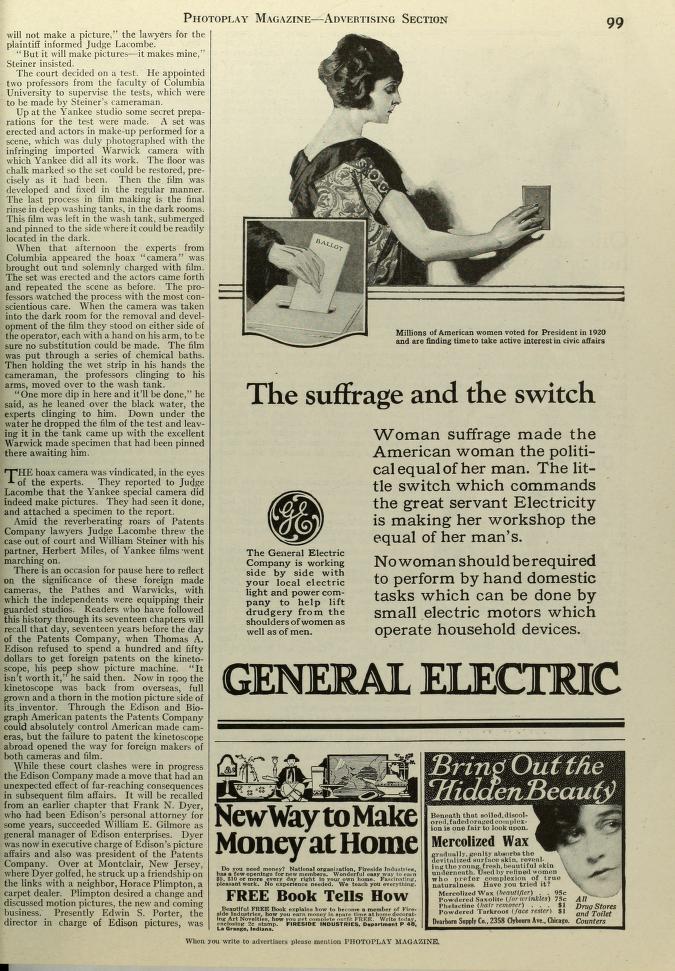
The Great Servant Electricity!


“Millions of American women voted for President in 1920 and are finding the time to take active interest in civic affairs.” Maybe that is because we, GE, give them electrical appliances? We’re just saying…

Movie magazines are a treasure trove of quirky old ads.  I'm sure I will be posting more of them in the future.

Next up, part two of Immortal Flower.

Wednesday, July 25, 2012

What does your signature reveal about you?

This week’s 1920s magazine post is from Movie Weekly, which is a bit more…sensationalist...than Photoplay (and Photoplay is not even that restrained, really).

Well, is it?
From Movie Weekly April 8, 1922. Click here to read the article.

Movie Weekly March 4, 1922 also has a pretty fabulous photo of Rudolph Valentino in his Sheik costume. Actors really stared in those old publicity photos. They’re looking at you, yes, you. Shhh…don’t speak, don’t speak.

And his hands do look large!
On page 6 and 7 of that issue is an article on what the movie stars' signatures reveal about them: 


“Success of Favorite Movie Stars Explained in Their Handwriting”
Click here to see the article more closely.

This is part two of a series! And apparently there will also be a ‘surprise handwriting’ article in an upcoming issue, if you happen to be a graphology enthusiast. The article begins with the classic space-filler found in many undergraduate essays – a definition:

“Fame has many faces. To be famous signifies the recognition of some sort of success achieved.”

Yes…go on…

“And no surer fashion of determining the essential elements which make for high popular acclaim can be found than that which an individual exhibits in handwriting. It is the intimate link between the nerve-action of the hand and the mind.”

I’m not convinced, but I’m willing to be entertained.

The signature of Constance Talmadge (star of films like Happiness a la Mode (1919) and Romance and Arabella (1919)) reveals that “her affections are potent, but her humorous eye would seize the amusing side of anyone who tried to be serious in a motor car.” 

So never drive anywhere with her, I guess.

Rudolph Valentino’s “even, well-poised fist moves ambitiously upwards, gesturing with his rather flamboyant capitals, exclamatory of his intense vitality and the conscious belief in himself.” Apparently, his “advance along the stellar way can be measured by the height of his signature. Very high.” 

This seems…a bit of a stretch?

The signature of Gloria Swanson (the woman standing in the riding pants) has a “virile swing” to match her “vigorous personality”.

Frankly, all of these descriptions sound the same to me! What do you all think? Are you convinced of graphology's vital utility?

Next up: the conclusion of Court of the Veils. For real this time!