Showing posts with label the best ads. Show all posts

Thursday, October 18, 2012

Hidden Egyptian!


Films! I really do love leafing through (or pressing the 'to the right' button through) these old movie magazines. So many absurd ads and glamour photos of film stars whose names are mostly forgotten...

This week in movie magazines, from Motion Picture Classic magazine (vol 9-11, 1920):


Stripey dress courtesy of Internet Archive, as usual

This article is an interview with actress Edith Storey and her super cute dog. It begins with the fabulous hook: "Have you ever stopped to think how many different kinds of love affairs there are? But of course you have; everyone does at some time or another!"

Don't be silly, of course you have!

Apparently one of these kinds of love affairs is a love affair with a favorite acting part. And Edith Storey's was with the part she played in "Dust of Egypt", a comedy. As Edith describes it: "In the beginning of the picture, I was an Egyptian princess. Nothing could stand in the way of my getting anything I wanted. I could take it or have it brought to me. My will was law absolute. And then the Princess died and her mummy came to life in the present century. (In the end it turns out that she was the creature of a dream)".  

It's not quite clear to me how this adds up to 'hidden Egyptian', but I suppose it's close enough.

Ancient Egypt is a perennial theme for films and was very popular in the 1920s - especially after the discovery of King Tutankamun's tomb in 1922 by Howard Carter (and his sponsor Lord Carnavon). Portrayals of  'the Orient' are often very much fascinated with the past, ancient-ness, and so on... Often the East was imagined to exist in a kind of perennial past or even state of timelessness.

And, for your entertainment, an advertisement for Palmolive which epitomizes this theme:

http://archive.org/stream/motionpicturecla1920broo#page/n331/mode/2up

Palmolive had a series of ads in the 1920s which portrayed the company as following in the footsteps of  ancient Egyptian use of palm and olive in beauty regimes. Often the ads paired an image of a modern American woman with an ancient Egyptian one. They're pretty amazing...and often quite startling? 

Can I mention that I just noticed that she's standing in the mummy coffin?! Is that the right word? Mummy case? Why would she be doing that? Why, Palmolive, why?

Next up, another Violet Winspear novel...

Wednesday, August 1, 2012

Ads from the Orient!

Well, not so much from the Orient as using the ‘Orient’ to sell things. Mostly perfume. These ads are all from Volume 24-25 of Photoplay (July-December 1923), found, as usual, on the Internet Archive.

First, you knew we couldn’t escape Valentino:

Made of lava, I presume?

See the ad.

The illustration probably refers to Valentino’s role in the film Blood and Sand (1922), which was not a sheik film but a film about a Spanish matador (Valentino) who is married to a virtuous woman and has an affair with a seductive widow, Doña Sol

Inside reference alert: in Court of the Veils, Duane Hunter refers to Isabela (the opera singer) as Doña Sol. Everything sheik connects to everything else sheik!

Anyway, the ad is for a face cream recommended to Valentino by his wife Winifred Hudnut (seen in this previous post). Apparently it builds up the facial muscles! And for only $2.00 (plus $1.50 for the Face Finish).  About $26.00 in today’s money, according to a random inflation calculator. So, pricey? Not pricey? I don't buy many face creams...

If you like that, you might like Vantine’s Temple Incense:


Lie back and relax...


This incense promises to bring you “all the mystery, the beauty and the lure of Eastern Romance”. And from the look of the woman in the illustration, it’s pretty alluring…

And then we have an advertisement for Sax Rohmer’s ‘Masterpieces of Oriental Mystery’:

Adventure, Romance, Sorcery, Secrets!


Sax Rohmer wrote a lot of ‘Oriental’ Mysteries (he’s best known for his mysteries featuring Dr. Fu Manchu). These ads are very common in movie magazines. This one encourages you to buy now, because this edition is at a special low price due to “a fortunate purchase of paper and other materials made at just the psychological moment”. The ads really capitalize on an image of the East (which includes a wide wide range of places in this case - China, India, Saudi Arabia, etc.) where women are bought and sold by mysterious (and probably unsavory) men.

See also, the Mountain Goats song “Sax Rohmer #1”.

And, finally, this one has nothing to do with sheik movies or romantic Orientalism, but I just love it:

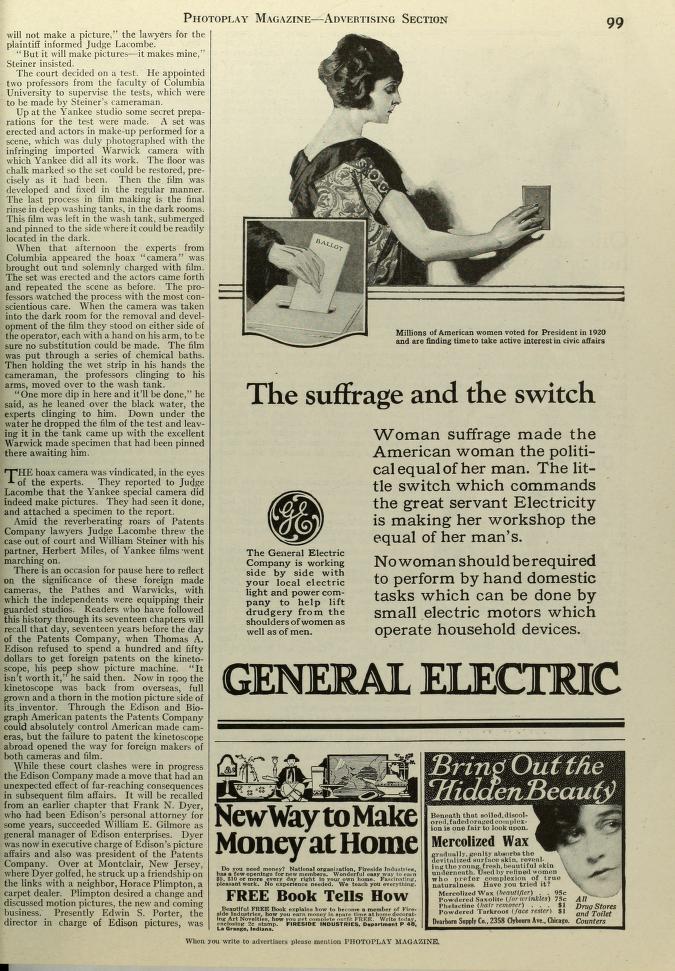
The Great Servant Electricity!


“Millions of American women voted for President in 1920 and are finding the time to take active interest in civic affairs.” Maybe that is because we, GE, give them electrical appliances? We’re just saying…

Movie magazines are a treasure trove of quirky old ads.  I'm sure I will be posting more of them in the future.

Next up, part two of Immortal Flower.

Wednesday, July 18, 2012

Zip! And Valentino’s futuristic abode…


As I mentioned last week, I’ve found some wonderful online archives of movie fan magazines up at the Internet Archive archive.org .  This is a fabulous resource for academics, enthusiasts and those of us who just really like finding old ads for underarm hair removal:
 
It's Off because it's Out!
I’ve been looking through some issues of Photoplay from the early 1920s and finding a lot of wonderful material. Today I’ll just post one photo-spread of Rudolph Valentino in his new house, waiting for his new wife.

And this little tidbit. Valentino, the star of the movie version of The Sheik, generated a lot of press, both positive and negative. The stereotype was that women loved him and men hated him (and thought he was too ‘feminine’). Thus this short ‘Song of Hate’:

http://archive.org/stream/photoplayvolume222chic#page/26/mode/2up

What are ‘oriental optics’? Eyes? Looks? I do love the phrase ‘apt in the art of osculation’.

And here is the man himself, Rudolph Valentino, looking very serious, from the September 1922 issue of Photoplay:

What more can be said of this Latin lover of the film?

These movie fan magazines had much of the same kind of content that Hollywood celebrity magazines have today (gossip about stars, spreads of their homes, interviews, reviews), as well as short fiction, ‘behind the scenes’ industry information, and so on. The following is a photo-spread of the home that Valentino was going to live in with his second wife after his divorce was final, described as “romance in silhouette against futuristic background”:


Photoplay September 1922


The spread, if you want to look at it more closely is at:
  
Their marriage was a bit of a scandal. According to the article, Valentino was not fully divorced from his first wife Jean Acker when he and Natacha Rambova (aka Winifred Hudnut) married in Mexico. There was even, I believe, a bigamy trial? The article says that Rudolph and Natacha designed the house together, but Valentino was living in it alone until they could marry legally in California while Rambova was living with her father Richard Hudnut (“millionaire perfume manufacturer”) in New York.

What a contrast in names! From Winifred Hudnut to Natacha Rambova! She was certainly going for the ‘exotic vamp’ image… Rambova had been a ballet dancer and was at the time an artistic and costume designer.  There were constant rumours in the film press about her relationship with Valentino and the amount of control she exerted over his artistic and business decisions (e.g. the notorious platinum ‘slave bracelet’ she bought him).   

This was common film star gossip (divorces and romances), but also inflected with the anxieties around changing gender relations which marked Valentino’s career. Was he manly enough or was he being controlled by his wife? Were women too sexually attracted to him? Was his foreignness the source of a suspicious sensuality?

More prosaically, though:

The picture of Valentino on the bottom left would be even more arresting in colour, because the caption describes his lounging suit (“from the Chinese”) as bright orange!

And the object on the bottom right is Natacha’s dressing table, apparently designed by Valentino himself with some ‘exotic and unique’ features, including an electric perfume burner. A nod, I suppose to both her exotic image and her father’s manufacturing interests?

Friday, we move forward in time to a sheik romance from the 1970s…