Showing posts with label real star scandals. Show all posts

Saturday, March 16, 2013

What becomes of their Wedding Rings!?


I started out this post trying to find a good scan of some of the early film fan magazines like Picture Stories which basically retold the stories of films that were out in theatre, with stills from the production. As in, they told the whole story (with varying degrees of accuracy), not just part of it for review purposes. Anyway, I wanted that because a friend had told me that my blog reminds her of Television Without Pity and other recap sites. So I wanted to find something that showed the long history of ‘recaps’ as a way of engaging with media.

But instead I found this, and there was no way that I could post anything else:

“What Becomes of their Wedding Rings?: The Merry – and Otherwise – Widows of Hollywood Dispose of Them Variously” by Dorothy Manners, Motion Picture Magazine, 1928.


Surprisingly, none of the stories involve throwing rings into the water.

Oh My God! Celebrity Wedding Rings of the 1920s! Ex-Wedding Rings! None of them are actually widows, so far as I can tell - all divorcees. I love texts from the past which remind us that tabloid journalism, celebrity schadenfreude, and divorces didn’t just start happening with the downfall of society in the 1980s (or any recent decade to which is attributed the beginning of the end of the supposedly idyllic past).

And don’t you just love that picture? Stars of today – dump your rings in the pond!

So, you may ask, what did the stars of the past do with their wedding rings, “that little band of gold with which they once took vows to love, honor and obey?  That little gold circlet that at one time stood for so much happiness, or unhappiness, or alimony, as the case may have been?” So many things!

Of course, “some of the Hollywood ladies refused to answer” – which is why you will probably not recognize any of the names of the film stars who did answer. Any publicity is good publicity if you're up and coming, I assume?

Priscilla Bonner (“the downtrodden damsel of the movies who has always been cast out in the snow with a baby in her arms – for publicity purposes” – of course) giggles as she reveals that she pawned her ring: “I needed the money a lot more than I did that solid gold reminder of a tinsel experience. Why shouldn’t I have sold it? I paid for it in the first place.”   

Why not, indeed?

Still others, like Jacqueline Logan, give them to their chauffeurs! Jacqueline Logan’s story has a lot of great rhetoric in it: “peppy and red-headed,” Jacqueline “didn’t have much luck in her matrimonial flyer with Ralph Gillespie.” As Manners puts it, “as a husband, Mr. Gillespie was a great luxury. The girl has a lot of sweet memories – all of bills.”  Ouch. 

Anyway, her chauffeur, a “young coloured gentleman named Freddie” was about to get married, but couldn’t afford a ring. Instead of paying him a higher salary, Jacqueline gave him her ring, with the statement that it’s “just as good as new, and you can have the initials crossed out.” You could probably write an entire paper about race, gender and narrative in 1920s Hollywood just from that story...

Others are more “lavender and old lace,” as Manners puts it, and still wear their rings or keep them safe in a drawer. For example, “the separation of Virginia and Jack Daugherty is very recent. The imprint of the ring still shows on her finger.” A more poignant touch.

And then, of course, there is the art of making a story out of what is essentially ‘no comment.’

Leatrice Joy (yes, her name is Leatrice) ‘won’t tell’ about the whereabouts of the ring from her marriage to Jack Gilbert: “it’s too personal and too intimate.”  And “Florence Vidor felt the same way. Only more so.”

Which is just to say that the rhetorical work of film fandom is endlessly fascinating. At least to me… Has anyone seen this kind of story in current magazines, or would it be too tacky for current tastes?

Back to romances next, a more recent one this time: The Sheik’s Christmas Bride.

Saturday, February 2, 2013

I'm back!

This blog has been quiet for a while for happy reasons; I've been defending my PhD about flexible labour and romance writing associations, teaching two courses and taking a trip to the UK with my girlfriend.

But now I have a bit more time (and mental energy), so it's back to all sheiks all the time. I still have a shelf-full of books to get through and I'm sure you were all waiting to hear what happens to the ballerina and the Russian sheik.  And you will find out in the next post!

Until then, here's a post on movie fan magazines by media scholar Anne Helen Peterson, who also occasionally writes fabulous gossip round-ups of classic star scandals on the Hairpin. Photoplay, how I love you!

Wednesday, July 25, 2012

What does your signature reveal about you?

This week’s 1920s magazine post is from Movie Weekly, which is a bit more…sensationalist...than Photoplay (and Photoplay is not even that restrained, really).

Well, is it?
From Movie Weekly April 8, 1922. Click here to read the article.

Movie Weekly March 4, 1922 also has a pretty fabulous photo of Rudolph Valentino in his Sheik costume. Actors really stared in those old publicity photos. They’re looking at you, yes, you. Shhh…don’t speak, don’t speak.

And his hands do look large!
On page 6 and 7 of that issue is an article on what the movie stars' signatures reveal about them: 


“Success of Favorite Movie Stars Explained in Their Handwriting”
Click here to see the article more closely.

This is part two of a series! And apparently there will also be a ‘surprise handwriting’ article in an upcoming issue, if you happen to be a graphology enthusiast. The article begins with the classic space-filler found in many undergraduate essays – a definition:

“Fame has many faces. To be famous signifies the recognition of some sort of success achieved.”

Yes…go on…

“And no surer fashion of determining the essential elements which make for high popular acclaim can be found than that which an individual exhibits in handwriting. It is the intimate link between the nerve-action of the hand and the mind.”

I’m not convinced, but I’m willing to be entertained.

The signature of Constance Talmadge (star of films like Happiness a la Mode (1919) and Romance and Arabella (1919)) reveals that “her affections are potent, but her humorous eye would seize the amusing side of anyone who tried to be serious in a motor car.” 

So never drive anywhere with her, I guess.

Rudolph Valentino’s “even, well-poised fist moves ambitiously upwards, gesturing with his rather flamboyant capitals, exclamatory of his intense vitality and the conscious belief in himself.” Apparently, his “advance along the stellar way can be measured by the height of his signature. Very high.” 

This seems…a bit of a stretch?

The signature of Gloria Swanson (the woman standing in the riding pants) has a “virile swing” to match her “vigorous personality”.

Frankly, all of these descriptions sound the same to me! What do you all think? Are you convinced of graphology's vital utility?

Next up: the conclusion of Court of the Veils. For real this time!

Wednesday, July 18, 2012

Zip! And Valentino’s futuristic abode…


As I mentioned last week, I’ve found some wonderful online archives of movie fan magazines up at the Internet Archive archive.org .  This is a fabulous resource for academics, enthusiasts and those of us who just really like finding old ads for underarm hair removal:
 
It's Off because it's Out!
I’ve been looking through some issues of Photoplay from the early 1920s and finding a lot of wonderful material. Today I’ll just post one photo-spread of Rudolph Valentino in his new house, waiting for his new wife.

And this little tidbit. Valentino, the star of the movie version of The Sheik, generated a lot of press, both positive and negative. The stereotype was that women loved him and men hated him (and thought he was too ‘feminine’). Thus this short ‘Song of Hate’:

http://archive.org/stream/photoplayvolume222chic#page/26/mode/2up

What are ‘oriental optics’? Eyes? Looks? I do love the phrase ‘apt in the art of osculation’.

And here is the man himself, Rudolph Valentino, looking very serious, from the September 1922 issue of Photoplay:

What more can be said of this Latin lover of the film?

These movie fan magazines had much of the same kind of content that Hollywood celebrity magazines have today (gossip about stars, spreads of their homes, interviews, reviews), as well as short fiction, ‘behind the scenes’ industry information, and so on. The following is a photo-spread of the home that Valentino was going to live in with his second wife after his divorce was final, described as “romance in silhouette against futuristic background”:


Photoplay September 1922


The spread, if you want to look at it more closely is at:
  
Their marriage was a bit of a scandal. According to the article, Valentino was not fully divorced from his first wife Jean Acker when he and Natacha Rambova (aka Winifred Hudnut) married in Mexico. There was even, I believe, a bigamy trial? The article says that Rudolph and Natacha designed the house together, but Valentino was living in it alone until they could marry legally in California while Rambova was living with her father Richard Hudnut (“millionaire perfume manufacturer”) in New York.

What a contrast in names! From Winifred Hudnut to Natacha Rambova! She was certainly going for the ‘exotic vamp’ image… Rambova had been a ballet dancer and was at the time an artistic and costume designer.  There were constant rumours in the film press about her relationship with Valentino and the amount of control she exerted over his artistic and business decisions (e.g. the notorious platinum ‘slave bracelet’ she bought him).   

This was common film star gossip (divorces and romances), but also inflected with the anxieties around changing gender relations which marked Valentino’s career. Was he manly enough or was he being controlled by his wife? Were women too sexually attracted to him? Was his foreignness the source of a suspicious sensuality?

More prosaically, though:

The picture of Valentino on the bottom left would be even more arresting in colour, because the caption describes his lounging suit (“from the Chinese”) as bright orange!

And the object on the bottom right is Natacha’s dressing table, apparently designed by Valentino himself with some ‘exotic and unique’ features, including an electric perfume burner. A nod, I suppose to both her exotic image and her father’s manufacturing interests?

Friday, we move forward in time to a sheik romance from the 1970s…

Wednesday, July 11, 2012

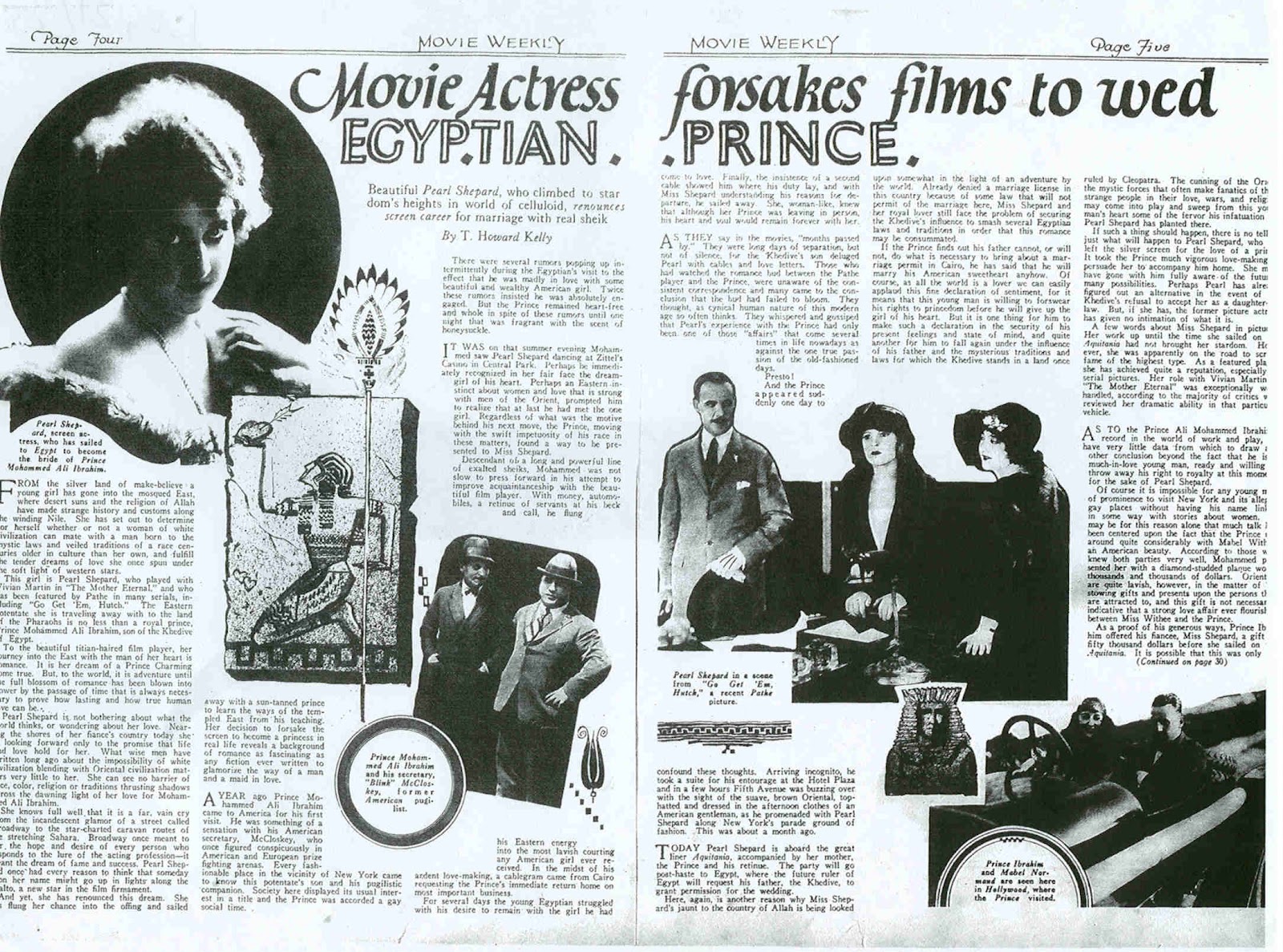
Movie Actress weds Egyptian Prince! Or does she?


Friday is the exciting conclusion of The Sheik but since it’s Wednesday today is 1920s day!  Join me in a journey into the Entertainment Weekly’s and People Magazine’s of the past…

Right now I’m working from scans of photocopies from microfilms (three levels of blurriness), but I’ve just discovered some digital archives that didn’t exist when I was doing my original research, so we might be getting some higher quality pictures up in here! Do people like the photos? I’ve put this one in at the ‘extra-large’ setting, but I suspect the text may still be too tiny to read.

Now to business:
 
“Movie Actress forsakes films to wed Egyptian Prince” actually has very little to do with mummies

This is an article from Movie Weekly July 21, 1923, right in the midst of the craze for all things Oriental (where Oriental is a fuzzy and expansive category encompassing Egypt, Morocco, Turkey, Saudi Arabia, India, China, Japan, and more!). Plus an actress marrying royalty is always compelling (Grace Kelly, anyone?).

Movie Weekly has spruced up this page with what I can only assume are intended to be ‘Egyptian’ details.  What I can’t figure out is why they’ve divided ‘Egyptian Prince’ into ‘Egyp’ dot ‘tian’ dot dot ‘Prince’ dot. It seems like the least natural place to put an ornamental dot!

Or maybe I’m just picky. In any case, the article is about Pearl Shepard, an American actress who appeared films with fabulous titles like Why Leave Your Husband? (1920), The Wages of Sin (1922) and Go Get ‘Em, Hutch (1922). 

Her ‘Egyptian Prince’ is Prince Mohammed Ali Ibrahim, whose uncle was the King of Egypt, according to the article. His father is the Khedive of Egypt, which Encyclopedia Britannica tells me was a position equivalent to that of Pasha and was replaced by the title Sultan in 1914, when Egypt became a protectorate of the British who, according to Wikipedia, deposed the Khedive at the time. But Movie Weekly was still using the title and I do not have enough knowledge about 20th century Egyptian politics to figure this thing out. More knowledgeable opinions are welcome! Also, if any of my students are reading: Wikipedia is not an acceptable source for a paper! Do as I say, not as I do!

The article really plays up the romance and exoticism of their story:

“From the silver land of make-believe a young girl has gone into the mosqued East, where desert suns and the religion of Allah have made strange history and customs along the winding Nile.  She has set out to determine for herself whether or not a woman of white civilization can mate with a man born to the mystic laws and veiled tradition of a race centuries older in culture than her own, and fulfill the tender dreams of love she once spun under the soft light of western stars.”

It also plays up the adjectives.                 

Love, as in all fictional sheik romances, is imbued by the writer with the power of bridging the presumed barriers of race and civilization; apparently, Pearl “can see no barrier of race, color, religion or traditions thrusting shadows across the dawning light of her love.” She’s even planning on giving up her film career!

The picture at the top left of the article is of Pearl Shepard herself and the picture in the middle left is of Prince Ibrahim and his secretary, mystifyingly enough, ‘Blink’ McCloskey, a former boxer. The Prince is described as a popular visitor to the New York social scene, “descended of a long and powerful line of exalted sheiks.”  He saw Pearl dancing at Zittel’s Casino in Central Park and then, perhaps “an Eastern instinct about women and love that is strong with men of the Orient, prompted him to realize that at last he had met the one girl.”

He pursued her, but was then called away on family business. They corresponded. Months passed and gossip spread that “Pearl’s experience with the Prince had only been one of those ‘affairs’ that come several times in life nowadays as against the one true passion of the old-fashioned days.” People were always more chaste in the old-fashioned days!

And then…Prince Ibrahim returned! And took Pearl on an ocean liner trip (accompanied by her mother, of course) to get permission to wed from his father.

But the path to true romance was not smooth…They could not marry in the US because of “some law that will not permit of the marriage here.” Movie Weekly is a little coy here, but this is presumably a reference to anti-miscegenation laws, although not necessarily. The racial status (in law) of Arabs was a contested topic in the 1920s and not everyone agreed. There could also, I suppose, have been a law against American movie actresses marrying foreign princes? But Movie Weekly says there might also be trouble on the Egyptian end, where they will need “the Khedive’s influence to smash several Egyptian laws and traditions in order that this romance may be consummated.”

What happened next? Well, Pearl Shepard’s IMDb page says that she married Prince Ibrahim and retired from acting. However, 'Looking for Mabel' (which seems to be a site about Mabel Normand, another American actress who Prince Ibrahim romanced) says that they in fact did not marry, implying that it was Pearl’s Jewish heritage (her real last name was Ginsburg?) that set the Khedive against her. As a side note, the ‘Looking for Mabel’ website looks fascinating, if you’re interested in silent film history. And its homepage has floating butterflies! 

Some very light googling turned up a reference to Pearl Shepard as Pearl Ginsberg (spelled with an ‘e’, but then again, the movie magazines spelled everyone’s names in a million ways. Rudolph Valentino got Rodolph, Rudolph, Rudolf, and so on) in  Time and in an archive of Los Angeles Examiner photos and clippings at USC, so her real name was almost definitely Ginsberg. 

But the definitive answer on if she married Prince Ibrahim or not, well that’s beyond me right now, I’m afraid! Another matter for the experts…

Up next: will Diana and the Sheik ever resolve their differences? What is the mystery in the Sheik’s past?